Ayurvedic Treatment for Knee Pain & Arthritis
Were you advised knee replacement surgery?
Many patients told they need a knee replacement have found lasting relief at Agasthya instead. At Kerala's NABH-certified Agasthya Ayurvedic Medical Centre, our non-surgical approach using Marma Chikitsa and Janu Vasti has helped patients from across India and abroad avoid surgery, reduce pain, and restore mobility in their knee joints.
Understanding Knee Pain — The Ayurvedic Perspective
In Ayurveda, knee pain and osteoarthritis are primarily understood as Sandhivata — a condition caused by the aggravation of Vata dosha in the joints. The knee joint (Janu Sandhi) is one of the most commonly affected weight-bearing joints. When Vata increases due to age, overuse, or constitutional factors, it depletes the natural lubrication (Shleshaka Kapha) that protects the joint surfaces, leading to cartilage wear, pain, and stiffness.
The Ayurvedic perspective recognizes that knee degeneration is not simply a local mechanical problem. It reflects a systemic imbalance where Vata dries out the joint tissues while Kapha, which normally provides cushioning and lubrication, becomes depleted. Toxin accumulation (Ama) in the joint space further aggravates inflammation. This is why painkillers and steroid injections provide only temporary relief; they do not address the underlying dosha imbalance or restore joint nourishment.
Common Types of Knee Conditions
Osteoarthritis (Sandhivata)
The most prevalent knee condition, particularly in patients over 50. Progressive loss of articular cartilage leads to bone-on-bone contact, causing pain during weight-bearing activities, morning stiffness, crepitus (crackling sounds), and gradual loss of range of motion. Graded from I to IV based on severity.
Meniscus Tear
The meniscus is a C-shaped piece of cartilage that acts as a shock absorber between the thighbone and shinbone. Tears can occur from sudden twisting movements or from gradual wear. Symptoms include pain along the joint line, swelling, locking or catching of the knee, and difficulty squatting or kneeling.
Rheumatoid Arthritis (Amavata)
An autoimmune condition where the body's immune system attacks the joint lining (synovium). In Ayurveda, this is understood as Amavata, where undigested metabolic toxins (Ama) combine with aggravated Vata and settle in the joints. Symptoms include symmetrical joint swelling, warmth, morning stiffness lasting over an hour, and fatigue.
Post-Surgical Knee Pain
Some patients experience persistent pain or stiffness after arthroscopic surgery, meniscectomy, or other knee procedures. Ayurvedic rehabilitation helps reduce residual inflammation, improve tissue healing, restore joint mobility, and strengthen the muscles that support the knee.
Why Conventional Treatments Often Fall Short
Standard treatment for knee pain typically follows a predictable path: painkillers, anti-inflammatory drugs, steroid injections, and eventually knee replacement surgery. While these approaches manage symptoms, they do not address why the joint is degenerating in the first place. Painkillers mask the pain while the cartilage continues to wear. Steroid injections may actually accelerate cartilage loss with repeated use. And knee replacement, while sometimes necessary, is a major surgery with significant recovery time and potential complications.
At Agasthya Ayurvedic Medical Centre, our approach works differently. By correcting the underlying Vata-Kapha imbalance, nourishing the joint tissues from within, and using targeted therapies like Janu Vasti to deliver healing directly to the knee, we help the body restore its own joint health naturally.
Conditions We Treat
Our specialized treatment protocols address a wide range of knee and joint conditions. Many of our patients come to us after being advised knee replacement surgery, and leave without needing it.
Osteoarthritis (Sandhivata)
Progressive wear and tear of knee cartilage causing pain, swelling, stiffness, and reduced range of motion. The most common form of knee arthritis, especially in those over 50.
Meniscus Tear
Damage to the crescent-shaped cartilage that cushions the knee joint, causing pain, swelling, locking, and difficulty with bending or straightening the knee.
Rheumatoid Arthritis
Autoimmune condition causing chronic inflammation of the knee joint lining, leading to pain, warmth, swelling, and progressive joint damage if untreated.
Knee Joint Effusion
Accumulation of excess fluid in the knee joint (water on the knee), often resulting from injury, arthritis, or overuse, causing swelling and restricted movement.
Post-Surgical Knee Pain
Persistent pain and stiffness following knee surgery, including arthroscopy or partial procedures, requiring rehabilitation and complementary treatment.
Ligament Injuries
Sprains or tears of the knee ligaments (ACL, MCL, or PCL) causing instability, pain, and swelling. Ayurvedic treatment supports recovery and strengthens surrounding tissues.
Our Treatment Approach — Marma Chikitsa
At the heart of our knee pain treatment is Marma Chikitsa — the ancient science of vital energy points. Our chief physician, Dr. T.D. Bose, trained under the legendary Marmacharya Shri Sudheer Vaidhyar, applies this knowledge to stimulate specific marma points around the knee joint. This helps release blocked energy, improve blood circulation to the joint, reduce swelling, and activate the body's natural healing response in the damaged cartilage and surrounding tissues.
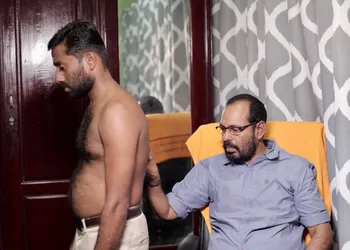
Dr. T.D. Bose during consultation
The Treatment Protocol
1. Assessment
Detailed evaluation including Prakriti (constitution) analysis, examination of knee joint mobility and alignment, review of X-rays and MRI reports, and assessment of gait and weight-bearing patterns.
2. Customized Plan
Based on the grade of arthritis, type of condition, and your overall constitution, a personalized treatment plan is designed combining Marma therapy, Janu Vasti, and supporting treatments.
3. Daily Treatment
Morning therapy sessions with Marma treatment focused on knee marma points, supporting therapies, internal medicines to reduce Vata and nourish joints, and dietary guidance.
Supporting Therapies for Knee Pain
Marma Chikitsa is enhanced with specialized Ayurvedic therapies that work together to reduce pain, nourish cartilage, and restore knee function:
Marma Abhyangam — Full body therapeutic massage stimulating marma points to reduce pain and inflammation in the musculoskeletal system.
Janu Vasti — A signature therapy for knee conditions. Warm medicated oil is retained over the knee using a dough dam, allowing deep penetration into the joint. This nourishes the cartilage, improves synovial fluid, and provides significant pain relief. Especially effective for osteoarthritis and stiffness.
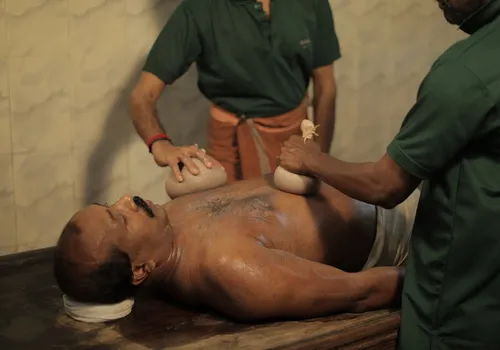
Muthira Kizhi — Horse gram bolus therapy that generates therapeutic heat, reduces swelling, and is particularly effective for joint stiffness and rheumatic conditions.
Pizhichil — Continuous stream of warm medicated oil poured over the body, deeply nourishing for joints, nerves, and muscles. Helps reduce Vata and improve overall joint flexibility.
Njavara Kizhi — Medicated rice bolus massage that nourishes weakened muscles, strengthens tissues around the knee, and promotes regeneration of damaged structures.
Ela Kizhi — Herbal leaf bolus massage to reduce inflammation, relieve joint stiffness, and improve local circulation around the knee.
Key Differentiators of Our Approach
Treatment Duration
We offer structured treatment programs based on the severity of your knee condition:
Have questions about your knee pain condition? Get expert advice now.
Why Choose Agasthya for Knee Pain Treatment
What to Expect — Your Treatment Journey
From your first contact to walking pain-free, here's what you can expect when you choose Agasthya for your knee pain treatment:
Step 1: Initial Consultation
Contact us by phone, WhatsApp, or through our contact page. You can have an initial consultation in-person or online. Bring your X-ray or MRI reports if available.
Step 2: Diagnosis & Assessment
Comprehensive evaluation including Prakriti (constitutional) analysis, physical examination of the knee joint, and review of your medical history and imaging reports to determine the grade of arthritis.
Step 3: Customized Treatment Plan
Based on your assessment, the doctor creates a personalized treatment plan with specific therapies including Janu Vasti, duration, internal medicines, and expected outcomes.
Step 4: Daily Treatment Sessions
Morning therapy sessions including Marma treatment focused on knee marma points and supporting therapies. Internal medicines are provided. Rest and gentle movement between sessions.
Step 5: Diet & Lifestyle Guidance
Therapeutic diet during your stay. Education on knee-friendly exercises, weight management, and lifestyle modifications to protect your joints long-term.
Step 6: Follow-up Care
Take-home medicines and detailed instructions for home care including oil application techniques. Follow-up consultations available in-person or online to monitor progress.
Related Articles
Chronic pain often causes stress and sleep problems. Learn how Shirodhara therapy complements joint pain treatment for holistic recovery.
Related Conditions
Many patients with knee problems also experience back pain. Learn more about our treatment:
Ayurvedic Back Pain Treatment →Disc problems can sometimes cause referred pain in the legs and knees. Learn more:
Disc Bulge Treatment Without Surgery →Sciatica can cause pain radiating from the back down to the knee. Learn about our treatment:
Sciatica Treatment Without Surgery →Arthritis patients often have cervical issues too. Learn about our neck pain treatment:
Cervical Spondylosis Treatment →Patient Success Stories
Read what patients with knee pain and arthritis have to say about their experience at Agasthya:
"I had knee pain due to meniscus tear. Allopathy said that only surgery is available. That's how I came here. My knee pain has subsided. The good cooperation of the doctors and staff — a heartfelt than..." Read more
"We first got treatment in 2009 — my wife was cured completely. When both of us had back and knee pain issues again, we visited in 2024 for 14 days. This is one of the most genuine centres I have ever ..." Read more
"I have just completed a 21 days treatment for chronic lower back pain. It has been a beneficial experience. I will strongly recommend Agasthya for all joint, bone, musculoskeletal and arthritis relate..." Read more
Watch: Patients Share Their Recovery Stories
Patient Recovery Story
Patient Recovery Story
Frequently Asked Questions
How long does Ayurvedic treatment for knee pain take?
Can Ayurveda help avoid knee replacement surgery?
What is Janu Vasti and how does it help knee pain?
Is the treatment effective for both osteoarthritis and rheumatoid arthritis?
Can elderly patients undergo knee pain treatment?
What lifestyle changes are needed after treatment?
Start Your Recovery Today
Don't let knee pain limit your life. Whether you're dealing with osteoarthritis, a meniscus tear, or chronic joint stiffness, our team is ready to help you find lasting relief through authentic Ayurvedic treatment.
Call us: +91 93884 77762
Online consultations available — Get expert advice from anywhere in the world
Medically reviewed by Dr. T.D. Bose, Chief Physician, Agasthya Ayurvedic Hospital. Last updated: March 22, 2026.