What Is Marma Chikitsa? The Ancient Therapy That Treats Chronic Pain
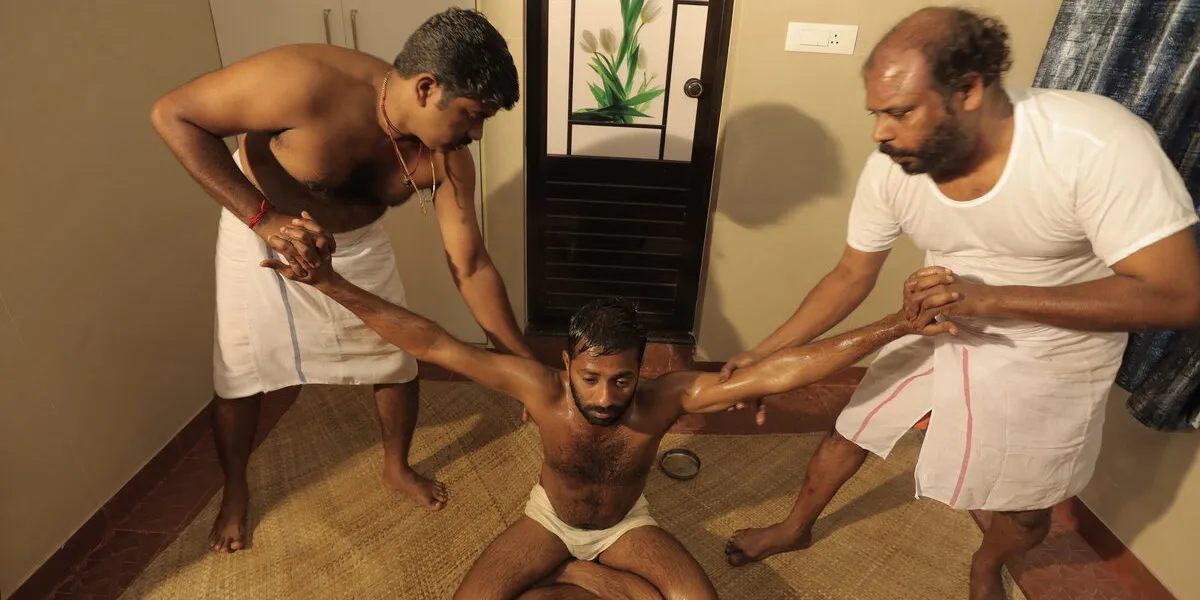
Table of Contents
The Ayurveda You Have Heard of Is Not the Ayurveda That Treats Pain
If you have ever had Ayurvedic treatment at a wellness centre or spa, you probably know it as oil massage, herbal medicines, and a calm room with a wooden table. That is the gentlest, most surface-level layer of Ayurveda — the part that has travelled around the world.
Underneath that layer sits something older, more specialised, and almost extinct: Marma Chikitsa, a clinical therapy that works on 107 vital points distributed across the human body. It is not massage. It is not relaxation. It is the branch of Ayurveda specifically built to treat chronic pain, joint conditions, spinal disorders, and nerve disorders — the kind of cases that conventional medicine often answers with surgery or a lifetime of painkillers.
At Agasthya Ayurvedic Medical Centre, Marma Chikitsa is the foundation of how we have treated 10,000+ patients over the past three decades — many of whom arrived at our doorstep with surgical recommendations from major hospitals. This article explains what Marma Chikitsa actually is, where it comes from, why so few practitioners can do it well, and what it can (and cannot) treat.
What "Marma" Means
The word marma comes from the Sanskrit root mri, which means "to die" or "to injure." In ancient Ayurvedic surgical texts, marma points were originally described in a battlefield context — these were the points on the body that, if struck, would cause death, unconsciousness, or serious injury. Sushruta, the surgeon-sage who wrote the Sushruta Samhita around 600 BCE, devoted an entire section to the anatomy of the 107 marma points.
But the same vital points that warriors used to disable an enemy were also used by physicians to heal. The classical texts describe marma points as junctions where five things converge:
- Mamsa (muscle)
- Sira (vessel)
- Snayu (ligament/tendon)
- Asthi (bone)
- Sandhi (joint)
In modern terms, these are the body's neurovascular hubs — points where nerves, blood vessels, fascia, and bones intersect. Stimulating them in a controlled, therapeutic way directly influences the underlying tissue, the nervous system, and the energetic flow Ayurveda calls prana.
The 107 Marma Points — A Quick Anatomy
The 107 marma points are distributed across the body in a precise pattern documented by Sushruta:
| Region | Number of marma points |
|---|---|
| Lower limbs (both legs) | 22 |
| Upper limbs (both arms) | 22 |
| Trunk (chest and abdomen) | 12 |
| Back (spine and surrounding) | 14 |
| Head and neck | 37 |
The points are further classified by size, by tissue type, and by what happens when they are injured versus stimulated. A trained Marma Chikitsa physician does not "press random spots." Each marma point has a name, a precise anatomical location, an associated tissue type, and a specific therapeutic function — and the practitioner selects which points to work on based on the patient's diagnosis.
For a patient with an L4-L5 disc bulge, for example, the protocol may involve a sequence of marma points along the lower back, the hips, and the legs — not because they correspond to "trigger points" in the muscle, but because they map onto the nerve roots and tissue planes that the disc is compressing.
Where Marma Chikitsa Comes From — and Why It Almost Disappeared
Marma Chikitsa is one of the eight classical branches of Ayurveda (Ashtanga Ayurveda), but unlike the others, it was never widely taught. The knowledge passed down through guru-shishya parampara — direct transmission from master to disciple — within a small number of family lineages, mostly in Kerala. Practitioners were called Marmacharyas ("marma masters") or Marma Vaidyas.
By the late twentieth century, that lineage had nearly broken. Modern Ayurvedic colleges teach the theoretical anatomy of marma points but do not produce clinical Marma Chikitsa physicians, because the practice cannot be learned from a textbook. It requires years of hands-on apprenticeship — the kind that is hard to standardise and harder to certify.
Dr. T.D. Bose, the chief physician at Agasthya, trained directly under Marmacharya Shri Sudheer Vaidhyar, one of the last great Marmacharyas of the old Kerala tradition. That lineage is part of why Agasthya treats the cases other Ayurvedic hospitals refer out — disc prolapse, IVDP, severe osteoarthritis, frozen shoulder, sciatica — and why patients travel from UAE, Canada, Belgium, France, Saudi Arabia, and across India to be treated here.
Marma Chikitsa and Kalaripayattu — The Same Map of the Body
The reason Kerala specifically held on to clinical Marma knowledge — long after it had thinned out elsewhere in India — is that it was kept alive by a parallel discipline: Kalaripayattu, the ancient Kerala martial art and arguably the oldest fighting system in the world.
Kalari and Marma Chikitsa share the same map of the human body. A Kalari warrior had to know the 107 marma points twice over: offensively, to strike or disable an opponent at a vital point in combat, and defensively, to treat the injuries those same points produced. Every serious Kalari gurukkal (master) was therefore also a healer. The fighting tradition and the healing tradition were not two professions — they were two sides of the same training.
The healing branch of Kalari is known as Kalari Chikitsa (sometimes Kalari Marma Chikitsa), and it is the direct ancestor of much of what is practised today as Marma Chikitsa in Kerala. Several signature techniques carry across:
- Uzhichil — the vigorous, full-body oil application used to recondition Kalari fighters is the precursor of Marma Abhyangam. Both work the same marma points along the limbs, back, and neck — one to keep a fighter supple, the other to release nerve compression and rebuild tissue in a patient.
- Bone-setting and spinal correction — Kalari healers were the orthopaedists of pre-modern Kerala, treating fractures, dislocations, and back injuries that Western medicine would now address surgically. The same hands-on diagnostic skill is what allows a Marma Chikitsa physician today to read a spine by touch.
- Internal medicines — the herbal formulations Kalari families used to speed recovery from combat injuries became part of the standard Marma Chikitsa pharmacopoeia.
Many of the family lineages that preserved Marma Chikitsa in Kerala — including the lineage Dr. Bose trained in — trace directly back to traditional Kalari households. When you receive treatment at Agasthya, you are receiving a clinical refinement of a knowledge system that survived two thousand years partly because warriors needed it. That is also why the therapy looks the way it does: precise, hands-on, and built around the body of someone who has to use their spine and joints, not just rest them.
How Marma Chikitsa Differs From "Regular" Ayurveda
This is the most common misunderstanding we encounter. Patients arrive having tried Ayurveda elsewhere — sometimes at well-known wellness centres in Kerala — and they tell us it did not work. That is not because Ayurveda failed them. It is because what they received was not Marma Chikitsa.
Here is the distinction in plain terms:
| Generic / wellness Ayurveda | Marma Chikitsa |
|---|---|
| Generic full-body oil massage (Abhyangam) | Targeted stimulation of specific marma points |
| Standardised treatment menu | Custom protocol based on diagnosis and MRI |
| Designed for relaxation, detox, general wellness | Designed for clinical pain and orthopaedic conditions |
| Often delivered by therapists | Delivered by physician-trained Marma practitioners |
| Soothing in the moment, limited long-term effect for chronic pain | Restores function and treats the root cause |
A wellness Abhyangam relaxes you. A Marma-based Marma Abhyangam re-routes blood flow and prana through specific marma points to reduce nerve compression and rebuild damaged tissue. The therapies look superficially similar. The clinical effect is not.
What Marma Chikitsa Treats
Marma Chikitsa is not a panacea. It is specifically powerful in conditions that involve the musculoskeletal system, the nervous system, and Vata-dosha imbalance — the bone, joint, and nerve disorders that classical Ayurveda groups under Vata Vyadhi. The conditions we treat most often at Agasthya:
Spine and disc conditions
- Disc bulge and disc prolapse (L4-L5, L5-S1, cervical levels)
- IVDP (Intervertebral Disc Prolapse)
- Sciatica and Gridhrasi
- Cervical spondylosis and brachial neuralgia
Joint conditions
- Knee pain and osteoarthritis (Sandhivata) — including patients advised total knee replacement
- Frozen shoulder, tennis elbow
- Rheumatoid arthritis (Amavata)
Back, neck, and chronic pain
- Chronic low back pain, lumbago
- Spondylolisthesis
- Carpal tunnel syndrome
- Plantar fasciitis
Other Vata-dominant conditions
- Diabetic neuropathy
- Sports injuries (ligament, tendon, joint)
- Post-stroke rehabilitation
The common thread: these are conditions where pain, inflammation, and nerve compression have become chronic, where conventional medicine offers either lifelong management or surgery, and where a Vata-pacifying therapy that addresses the root tissue layer can restore function.
What a Marma Chikitsa Course Actually Looks Like
A Marma Chikitsa course at Agasthya is not a one-size-fits-all package. It is sequenced — different therapies enter and exit at different points in the course, building on each other. Course length is matched to diagnosis: short courses of 3, 5, or 7 days for milder conditions or rejuvenation, and full in-patient courses of 14, 18, or 21 days for chronic disc, joint, and spine cases.
A 21-day flagship course for a complex disc or joint case typically combines five core therapies, sequenced across the stay:
| Therapy | Sessions in a 21-day course | Purpose |
|---|---|---|
| Marma Abhyangam (oil application across marma points) | 7–9 | Backbone of the course — opens up marma points, prepares tissues |
| Bashpa Swedam (medicated steam) | 3–5 | Loosens tissues after Abhyangam, drives oils deeper |
| Pizhichil (continuous warm oil stream) | 3–5 | Deep nerve and tissue nourishment, especially mid-course |
| Njavarakizhi (medicated rice bolus) | 5–7 | Strengthens muscles supporting the spine and joints, late phase |
| Shirodhara / Shiro Abhyangam | 3–5 | Calms the nervous system, supports cases with insomnia or radiating pain |
On top of this backbone, condition-specific adjuncts are added — Nasyam for cervical and head-region cases, Upanaham and Dhanyamla Dhara over the lumbar region for lower-back disc problems, Upanaham and Kulathakizhi over the knee for osteoarthritis, and Naranga Kizhi (lemon bolus) or Ela Kizhi (herbal leaf bolus) for inflamed joints. Internal Ayurvedic medicines are taken throughout the course, and individual therapies are scheduled by the doctors so that no two run on the same day unnecessarily — every session has a purpose in the larger sequence.
Shorter courses follow the same logic at smaller scale. A 7-day plan, for example, may combine 3 Abhyangam + 3 Sirodhara + 3 Njavarakizhi + 3 Nasyam for a cervical or stress-related case, while a 14-day disc-bulge course may run 5 Abhyangam + 3 Bashpa Swedam + 3 Pizhichil + 7 Njavarakizhi. The 3- and 5-day plans are generally for rejuvenation or mild Vata-imbalance cases, not for chronic spine or joint conditions.
Discharge and aftercare. In the final days the doctors brief you on the take-home medicine schedule, the mandatory 2–3 month rest period (during which softened bones and ligaments strengthen back up), and the do's and don'ts. Take-home oils and internal medicines continue for 2–3 months, with phone and online follow-ups, and medicines couriered as needed.
Most patients — even those who arrived in significant pain — report meaningful improvement within the first 7–10 days of treatment. The full benefit, however, only consolidates during the post-treatment rest phase.
A Patient's Story — IVDP and Sciatica, Surgery Recommended Abroad
Ranjith P, a Malayali working in the UAE, came to Agasthya in February 2023 with severe IVDP and sciatica. Discs were involved at the L4 and L5 levels. His leg pain had become worse than his back pain — shooting, with sensation changes in the foot, muscle spasms, weakness, and numbness in his toes. He was not able to walk. The doctors he had consulted in the UAE had recommended an operation.
He chose to come home and try Marma Chikitsa first. His 14-day in-patient course at Agasthya included exactly the protocol described above — Marma Abhyangam for whole-body and back, Pizhichil, and Njavarakizhi — with treatments running each morning and a daily walking practice prescribed by the doctors in the morning and evening. In his own words:
"I was totally cured after 14 days. I took another 15 days compulsory rest at home and back to my routine jobs at UAE now."
His case is not unusual. It is, in our experience, what Marma Chikitsa is built to do — a 14-day in-patient course followed by a disciplined rest period — when the diagnosis is correct, the lineage is real, and the patient follows the post-treatment protocol. You can read Ranjith's full account and 140+ other recovered-patient stories on our testimonials page.
The Cost of Marma Chikitsa Treatment
Authentic, in-patient Marma Chikitsa at a NABH-certified hospital costs a fraction of what spine or knee surgery costs in a private hospital. Health insurance is accepted at Agasthya, and cashless options are expanding with our NABH certification. For a full breakdown of pricing — including treatment, accommodation, food, and medicines — see our detailed guide on the cost of Ayurvedic treatment in Kerala.
How to Know If Marma Chikitsa Is Right for You
Marma Chikitsa is not the right therapy for every condition or every patient. It is most likely to help if:
- You have a chronic pain or musculoskeletal condition that has not responded fully to conventional treatment
- You have been advised surgery for a disc, joint, or spine condition and want to try a non-surgical option first
- You have been on long-term painkillers and want to address the root cause rather than continue masking symptoms
- You can commit to 14–21 days of in-patient treatment and a 2–3 month rest period afterwards
It is less suited to acute emergencies, cancers, advanced cardiac conditions, or cases requiring urgent surgical intervention. In those cases, our doctors will say so honestly during consultation.
The simplest first step is to share your MRI and reports with us for a free review — no commitment, no travel needed. Our doctors will tell you whether your specific case is a good fit for Marma Chikitsa, and what to realistically expect from treatment.
Talk to Our Doctors
If you are considering Marma Chikitsa for a chronic pain, disc, or joint condition, the next step is a free consultation. Share your MRI on WhatsApp for a same-day review, or book a video consultation with Dr. T.D. Bose.
- WhatsApp: +91 93884 77762
- Call: +91 93884 77762
- Online consultation: Book here — patients consult from UAE, Canada, Delhi, and beyond
You can also read more about Marma Chikitsa as a treatment, or browse recovered-patient stories.
Medically reviewed by Dr. T.D. Bose, Chief Physician, Agasthya Ayurvedic Medical Centre. Dr. Bose trained under Marmacharya Shri Sudheer Vaidhyar and has practised Marma Chikitsa for over 30 years.
Related Treatment
Learn more about this treatment at Agasthya
Written by
Dr. T.D. BoseChief Physician at Agasthya Ayurvedic Medical Centre with 30+ years of experience in Marma Chikitsa and traditional Ayurvedic treatments.
Have questions about this treatment?
Share your reports on WhatsApp for a personalized consultation.