Cervical Radiculopathy Treatment — Ayurvedic, Without Surgery
Cervical radiculopathy treatment in Kerala — lasting relief from neck and arm nerve pain, without surgery, long-term painkillers or repeated injections.
When a disc bulge or bony spur pinches a nerve root in your neck, the pain, numbness or weakness travels down the shoulder and arm into the hand — this is cervical radiculopathy. The good news: most cases improve without an operation. At Kerala's NABH-certified Agasthya Ayurvedic Medical Centre, Marma Chikitsa with Nasyam has helped 10,000+ patients with cervical and nerve-compression conditions find lasting relief. Online consultation available before you travel.
Share your MRI on WhatsApp for a free review — no obligation, no travel needed.
Relief Without Surgery, Painkillers, or Repeated Injections
Most cervical radiculopathy is managed without an operation — the medical literature reports that the large majority of patients improve with non-surgical care. Cervical fusion or discectomy (ACDF) is generally reserved for severe or progressive nerve damage, and it carries real risks: infection, nerve injury, and stiffness or new problems at the neighbouring level.
Painkillers and steroid injections can dull the pain, but they do not relieve the pressure on the nerve root — so the symptoms often return. Our approach works in exactly the space where most radiculopathy resolves: reducing the inflammation and muscle spasm around the compressed root so the arm pain settles at its source.
And the cost? A fraction of cervical spine surgery. We accept health insurance, and cashless options are expanding with our NABH certification.
Try Ayurvedic treatment for 14–21 days before considering surgery. If you don't improve, the surgical option is still there — but surgery cannot be undone.
What Cervical Radiculopathy Actually Means
Your neck has seven vertebrae (C1 to C7), and a nerve root exits the spine on each side at every level. Radiculopathy means one of those nerve roots is being pinched — most often by a disc bulge or a bony spur that narrows the small canal (the foramen) through which the root leaves the spine. Because that root carries sensation and power to a specific part of the arm, the symptoms don't stay in the neck: they travel down the shoulder, arm and into the hand.
This is different from two conditions it is often confused with. Cervical spondylosis is the underlying age-related wear of the discs and joints — it can cause neck pain and stiffness with no arm symptoms at all. Cervical myelopathy is when the spinal cord itself — not just a root — is compressed, which is more serious. Radiculopathy sits in between: the degeneration or disc has gone one step further and is pressing on a nerve root. The C5-C6 and C6-C7 levels are affected most often, because they move and bear load the most.
In Ayurveda, this radiating arm pain is understood as Vishwachi — a disorder of aggravated Vata dosha travelling along the nerve channels of the arm. (This is distinct from Greeva Stambha, the neck-stiffness pattern of cervical spondylosis.) Our treatment, led by Dr. T.D. Bose, pacifies that Vata and relieves the pressure on the root — the same Marma Chikitsa approach we use across all our spine and nerve conditions.
One more thing worth separating out: if the pain sits mainly in the shoulder itself with a stiff, hard-to-move joint rather than travelling down the arm, it may instead be a frozen shoulder (Apabahuka) — a different problem we also treat.
If your numbness is mainly in the hand and fingers and worse at night, the nerve may instead be pinched at the wrist — see our carpal tunnel syndrome treatment page (sometimes the nerve is squeezed at both the neck and the wrist — a ‘double crush’).
Signs & Symptoms by Nerve Root
Which nerve root is pinched decides where in the arm you feel it. Matching your symptoms to the root helps confirm what your MRI shows and guides the treatment:
C5 nerve root (often from the C4-C5 level)
- Pain over the shoulder and the outer upper arm
- Weakness lifting the arm out to the side (deltoid) and bending the elbow (biceps)
- Numbness is usually limited to the shoulder region
C6 nerve root (often from the C5-C6 level)
- Pain or numbness down the outer forearm into the thumb and index finger
- Weakness bending the elbow (biceps) and cocking the wrist back (wrist extension)
- A reduced biceps or brachioradialis reflex
C7 nerve root (often from the C6-C7 level)
- Pain or numbness down the back of the arm into the middle finger
- Weakness straightening the elbow (triceps) and the wrist
- A reduced triceps reflex
C8 nerve root (often from the C7-T1 level)
- Pain or numbness into the ring and little fingers and the inner forearm
- Weakness of grip and the small muscles of the hand
- Difficulty with fine tasks such as buttoning a shirt or holding small objects
When to seek care urgently
An unsteady or clumsy walk, dropping objects or fumbling with buttons and coins, heaviness or weakness in both hands or legs, or any change in bladder or bowel control can signal that the spinal cord itself is being compressed (cervical myelopathy) — not just a nerve root. This is uncommon, but it needs prompt medical assessment before any elective treatment. If you have these signs, seek care urgently.
How Cervical Radiculopathy Is Diagnosed & Reading Your MRI Report
Diagnosis starts with the pattern of your symptoms. Because each nerve root supplies a specific finger, muscle and reflex, a careful clinical exam — testing sensation, strength and reflexes in the arm — points to the level involved. A common bedside test is Spurling's test: gently tilting and extending the head towards the painful side briefly narrows the foramen, and if it reproduces the arm pain, it strongly suggests a pinched root.
An MRI is the gold standard to confirm which disc or spur is pressing on which root. Cervical MRI reports use specific words — knowing them helps you understand your own scan:
Neural foraminal stenosis
Narrowing of the bony canal where the nerve root exits the spine — one of the commonest causes of cervical radiculopathy. Reports grade it mild, moderate or severe.
Uncovertebral (uncinate) hypertrophy
Bony spurs on the small uncovertebral joints at the sides of the vertebrae. They narrow the exit canal and pinch the nerve root — a classic neck finding.
Disc-osteophyte complex
A bulging disc and a bony spur pressing together on the nerve root — very common in cervical reports, especially at C5-C6 and C6-C7.
Nerve-root impingement vs. cord signal change
“Impingement” or “compression” of a root causes radiculopathy (arm symptoms). A “cord signal change” or “myelomalacia” means the spinal cord itself is affected (myelopathy) — a more serious finding that needs prompt review.
Central canal stenosis
Narrowing of the main canal that houses the spinal cord. Mild narrowing is common; significant narrowing with cord contact is watched more closely.
What the research shows
You don't have to take this on faith. A peer-reviewed review in HSS Journal, indexed in the U.S. National Library of Medicine (PubMed Central), reports that 75–90% of people with cervical radiculopathy improve with non-surgical management — surgery is generally reserved for severe or progressive nerve damage. That conservative, non-surgical window is exactly where our Ayurvedic treatment works: easing the inflammation and pressure on the nerve root so the arm pain settles. Every patient is different, and we give an honest assessment of your MRI before you travel.
Already have an MRI? Send it to us for a free, no-obligation review.
Get a Free MRI ReviewHow Marma Chikitsa + Nasyam Treat the Pinched Nerve
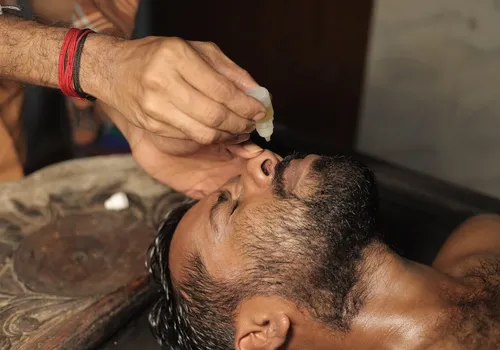
Our approach is led by Dr. T.D. Bose, who trained under Marmacharya Shri Sudheer Vaidhyar. For a pinched cervical root, our doctors stimulate the marma points of the neck, shoulder and upper back to release the muscle spasm and inflammation squeezing the root, improve circulation, and ease the pressure on the affected C5, C6, C7 or C8 nerve — supported by Nasyam (medicated nasal therapy that reaches the head and neck), Marma Abhyangam, Upanaham, Pizhichil, Njavarakizhi and internal Ayurvedic medicines.
This is the same cervical protocol we describe in full on our main cervical spondylosis treatment page — here focused specifically on the pinched nerve root. It is non-surgical, drug-free, and addresses the root cause rather than masking pain. Most patients complete a 7–21 day in-patient course followed by take-home medicines, ergonomic changes and prescribed neck care.
Why patients choose us for cervical nerve pain
Diet, Lifestyle & Movement for a Healthy Neck
How you sit, sleep, and use screens every day either protects your neck or keeps the nerve irritated. The right habits ease pressure on a compressed cervical root and help treatment hold. Our doctors give each patient personalised guidance — these are the principles we share most often.
Do
Eat warm, freshly cooked, easily digestible meals — they pacify Vata, the dosha behind nerve pain in Ayurveda.
Favour anti-inflammatory foods: cooked vegetables, whole grains, ginger, turmeric, and healthy fats like ghee in moderation.
Set your screen at eye level so you look straight ahead, not down, and take a posture break every 30–45 minutes.
Use a supportive pillow that keeps the neck neutral — neither propped too high nor flat.
Keep the neck warm and stay well hydrated.
Move gently within pain-free limits, and follow the supervised neck care your doctor prescribes.
Avoid
Long hours looking down at a phone or laptop ('text neck').
Heavy lifting and overhead work while the nerve is irritated.
Thick or unsupportive pillows and sleeping face-down with the neck twisted.
Sudden, jerky neck movements and self-administered neck 'cracking'.
Unsupervised deep stretches or gym routines that can worsen root compression.
Cold, dry, or heavily processed foods that aggravate Vata.
A note on movement: during recovery, all neck movement should be gentle and supervised. Our doctors prescribe a personalised plan — never self-prescribe intensive neck exercises with an actively pinched nerve.
Recovery Stories from Our Patients
Cervical radiculopathy sits within our wider spine and nerve-pain practice. Here are recent recovery stories from patients we've treated:
"I was admitted for Ayurvedic treatment to get relief from ailments caused by a compression fracture on my backbone from a vehicle accident. Even after all possible corrective treatments by an orthopae..." Read more
"After some accidents I developed a disc-bulging problem, and the back pain became unbearable. I could barely walk when I was admitted, but from the very first day I began to feel relief. The treatment..." Read more
"I was there for my back pain treatment. The treatment was for 21 days. The people who worked there were very humble, and the pricing was reasonable for their work. It has definitely helped with my ach..." Read more
Cervical Radiculopathy — Frequently Asked Questions
Can cervical radiculopathy be cured without surgery?
What is the best Ayurvedic treatment or medicine for cervical radiculopathy in Kerala?
My MRI says “C6-C7 disc-osteophyte complex with nerve root compression” — is that serious?
What is the difference between cervical spondylosis and cervical radiculopathy?
What exercises or activities should I avoid with a pinched neck nerve?
How long does cervical radiculopathy treatment take?
Neck Pain Radiating Into Your Arm? Talk to Us First
Before you commit to surgery or resign yourself to painkillers, share your MRI with our doctors for a free, no-obligation review. We'll tell you honestly whether our non-surgical approach can relieve your pinched nerve — the same one that has helped 10,000+ patients.