Ayurvedic Treatment for Back Pain in Kerala — Without Surgery
Ayurvedic treatment for back pain in Kerala — 90-95% of our patients improve without surgery, even those advised spinal fusion.
Diagnosed with chronic back pain, lumbar disc bulge, sciatica or spondylosis? At Kerala's Agasthya Ayurvedic Medical Centre, Marma Chikitsa has helped 10,000+ patients across 30+ years avoid back surgery and return to pain-free living. Online consultation available — patients consult from UAE, Canada, Delhi, and beyond before travelling.
Tell us your symptoms — share an MRI report if you have one. Dr. Bose's team replies within an hour with an honest assessment. No travel, no obligation. Prefer a form? Book a consultation here.
“Doctors in UAE recommended surgery for my back pain and sciatica — I couldn't even walk. After 14 days at Agasthya I was totally cured. After 15 days rest at home I was back to my routine work in UAE.”
Ranjith P · UAE
Considering Back Surgery? Consider This First
Spinal surgery for back pain carries real risks: infection, nerve damage, failed back surgery syndrome, and repeat procedures. Many patients who undergo discectomy or spinal fusion continue to live with pain or develop new problems at adjacent levels within a few years.
We've treated thousands of patients in Kerala and abroad who were advised back surgery. In our experience, many cases — even those with significant disc involvement or chronic pain — respond well to ayurvedic back pain treatment given 14–21 days.
And the cost? A fraction of spinal fusion or disc replacement surgery. The total comprises treatment fees plus accommodation — single, double, AC and non-AC rooms at reasonable rates with food at ₹350 per day. We accept health insurance, and cashless options are expanding with our NABH certification. Get a personalised estimate on WhatsApp →
Try ayurvedic treatment for back pain for 14–21 days before deciding on surgery. If you don't see improvement, you can always operate later. But surgery cannot be undone.
Why Ayurvedic Treatment for Back Pain Works — The Ayurvedic Perspective
In Ayurveda, back pain is primarily understood as a manifestation of Vata dosha imbalance. The condition is referred to as Kati Shoola (lower back pain) or Gridhrasi (sciatica) in classical Ayurvedic texts. When Vata, the dosha governing movement and nerve function, becomes aggravated or blocked, it leads to pain, stiffness, and reduced mobility in the spine.
The Ayurvedic approach recognizes that back pain is rarely just a local problem. It often reflects deeper imbalances in the body — poor digestion leading to toxin accumulation (Ama), weakened tissues (Dhatu Kshaya), or blocked energy channels (Srotas). This is why conventional treatments that focus only on pain relief often fail to provide lasting results.
Common Types of Back Pain
Lower Back Pain (Lumbar)
The most common form, affecting the L1-L5 vertebrae. This region bears most of the body's weight and is susceptible to disc problems, muscle strain, and degenerative changes. Patients often experience dull aching, stiffness, and difficulty in bending or standing for long periods.
Upper Back Pain (Thoracic)
Less common but can be equally debilitating. Often related to poor posture, especially in those who work long hours at computers. May present with pain between the shoulder blades and difficulty in taking deep breaths.
Acute vs. Chronic
Acute back pain comes on suddenly, often after an injury or sudden movement, and typically resolves within a few weeks. Chronic back pain persists for more than 12 weeks and often indicates underlying structural or degenerative issues that require comprehensive treatment.
Modern Causes, Ancient Solutions
Today's lifestyle has created an epidemic of back pain. Prolonged sitting at desks, lack of physical activity, poor posture while using phones and computers, and high stress levels all contribute to spinal problems. Add to this the natural degenerative changes that occur with age — disc dehydration, facet joint wear, and ligament stiffening — and it's no wonder back pain has become one of the leading causes of disability worldwide.
At Agasthya Ayurvedic Medical Centre, we combine time-tested Ayurvedic wisdom with an understanding of modern lifestyle factors to provide treatment that addresses both the symptoms and root causes of your back pain.
Back Pain Conditions We Treat
Our specialized treatment protocols are designed for a wide range of back pain conditions. Many of our patients come to us after being advised surgery, and leave without needing it.
Lumbar Spondylosis
Age-related wear and tear of the spinal discs and vertebrae in the lower back, causing stiffness and chronic pain.
Disc Bulge / Disc Prolapse
Herniated discs, most commonly at L4-L5 and L5-S1 levels, causing nerve compression, radiating pain, and numbness in legs.
Sciatica
Sharp, shooting pain radiating from the lower back through the buttock and down the leg along the sciatic nerve.
Cervical Spondylosis
Degenerative changes in the neck vertebrae causing neck pain, stiffness, and sometimes radiating pain to shoulders and arms.
Degenerative Disc Disease
Progressive deterioration of spinal discs leading to chronic pain, reduced mobility, and nerve irritation.
Post-Surgical Back Pain
Persistent pain following spinal surgery, often requiring rehabilitation and complementary treatment approaches.
Muscle Spasms & Chronic Stiffness
Recurring muscle tension and stiffness in the back due to postural issues, stress, or underlying conditions.
How Marma Chikitsa Treats Back Pain
At the heart of our treatment philosophy is Marma Chikitsa — the ancient science of vital energy points. Our chief physician, Dr. T.D. Bose, trained under the legendary Marmacharya Shri Sudheer Vaidhyar, has refined this approach over three decades to achieve remarkable results in treating back pain.
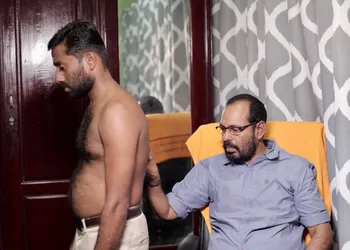
Dr. T.D. Bose during consultation
The Treatment Protocol
1. Assessment
Detailed evaluation of your condition including Prakriti (constitution) analysis, examination of posture and mobility, and review of medical reports.
2. Customized Plan
Based on your unique condition, a personalized treatment plan is created combining specific Marma therapies and supporting treatments.
3. Daily Treatment
Morning therapy sessions with Marma treatment, supporting therapies, internal medicines, and dietary guidance.
Supporting Therapies for Back Pain
Marma Chikitsa is enhanced with specialized Ayurvedic therapies that work synergistically to reduce pain, heal tissues, and restore function:
Upanaham — A warm medicated paste poultice bandaged over the affected lumbar region, often overnight. Sustained warmth and deep herbal penetration relax paraspinal spasm and reduce localised inflammation around compressed nerve roots.
Dhanyamla Dhara — A continuous warm stream of fermented grain decoction over the back. Particularly effective in inflammatory back pain, sciatic flare-ups, and Vata-aggravated chronic cases.
Marma Abhyangam — Therapeutic massage stimulating marma points along the spine to reduce pain, release muscle spasms, and improve circulation.
Internal Medicines — Specific Ayurvedic formulations to pacify Vata, support nerve health, and reduce inflammation from within.
Pizhichil — Continuous stream of warm medicated oil poured over the body, deeply nourishing for nerves and muscles.
Njavara Kizhi — Medicated rice bolus massage that nourishes muscles, strengthens the spine, and promotes tissue regeneration.
Muthira Kizhi — Horse gram bolus therapy, particularly effective for rheumatic conditions and low back pain.
Ela Kizhi — Herbal leaf bolus massage to reduce inflammation and stiffness.
Key Differentiators of Our Approach
Which Marma Points We Work for Back Pain
Classical Ayurveda identifies 107 marma points across the body. For lumbar disc, sciatica, and chronic back pain, our therapists work a specific subset along the spine, sacrum, and pelvis. Each point governs muscle tone, nerve conduction, or joint mobility in the lower back — releasing them in the right sequence is what distinguishes Marma Chikitsa from generic Ayurvedic massage.
Katikataruna Marma
Paired lumbar paraspinal points that govern lower back stability. Releasing these reduces paraspinal spasm — the most common pain driver in L4-L5 disc cases.
Nitamba Marma
Located above the iliac crest. Frequently involved in sciatic referral — work here often relieves radiating leg pain that drug therapy could not reach.
Kukundara Marma
Sacral region points. Critical for patients with L5-S1 prolapse, post-surgical pain, and sacroiliac involvement.
Gudha Marma
Deep pelvic floor point. Addresses the postural and pelvic-tilt component of chronic low back pain.
Our Sequenced Back Pain Protocol — How the Therapies Stack Across 14-21 Days
Generic Ayurvedic massage will not move a chronic disc problem. What works is a sequenced protocol in which the right therapy is given at the right phase — acute pain control first, then deep tissue work, then strengthening. Dr. Bose finalises the exact sequence and oil selection after reviewing your MRI and examining your case, but the typical arc looks like this:
Days 1-5 — Acute Pain & Spasm Control
Abhyangam (full-body warm medicated oil massage) by 2-3 therapists working the spinal marmas, followed by Bashpa Swedam (medicated steam). In inflammatory or sciatic-flare presentations we layer in Dhanyamla Dhara — a continuous warm stream of fermented grain decoction over the back that pacifies acutely aggravated Vata and reduces nerve root irritation. Internal medicines (typically Dashamoolarishta, Maharasnadi kashayam, or condition-specific formulations) begin from day 1.
Days 5-12 — Deep Tissue Work & Localised Penetration
Pizhichil — a continuous warm medicated oil stream poured over the whole body — deeply nourishes nerves and lubricates spinal tissues. We add Upanaham for localised work: a warm herbal paste poultice is bandaged over the affected lumbar segment, often kept on overnight, so the medicine penetrates the paraspinal muscles and the soft tissue around the compressed disc for hours rather than minutes. For stiffness-dominant or rheumatic presentations, Kulathakizhi (horse gram bolus) or Elakizhi (herbal leaf bolus) is used in this phase.
Days 12-21 — Strengthening & Tissue Rebuilding
Once acute pain has settled, we layer in Njavarakizhi — bolus pouches packed with Njavara rice cooked in herbal milk decoction, used to massage the back, hips, and legs. The combination of warm bolus pressure, nutritious milk-rice contact, and herbal infusion nourishes paraspinal muscles, strengthens spinal ligaments, and improves blood supply to the affected discs. This is the phase that rebuilds what chronic back pain has wasted, and it is what makes the relief last.
Internal medicines, a Vata-pacifying therapeutic diet, and Marma point work run through all three phases. The total in-patient course is followed by 2-3 months of take-home medicines, oils, and a strict rest protocol at home — that post-treatment window is where the recovery actually consolidates.
“I was treated at Agasthya for acute back pain following Inter Vertebral Disc Prolapse. I was admitted for 21 days and was given various Ayurvedic treatment procedures. Recovery was slow unlike other medical treatment but I was completely alright by about 6 months. I never had to look back after that.”
Dr. Aniamma Mathew — writing 6 years after treatment
Read the full case study: How Dr. Aniamma Mathew recovered from a lumbar disc prolapse in 21 days →
Treatment Duration
We offer structured treatment programs based on the severity of your condition:
Have questions about your back pain condition? Get expert advice now.
Why Agasthya Is the Best Back Pain Treatment in Kerala
What to Expect — Your Treatment Journey
From your first contact to returning home pain-free, here's what you can expect when you choose Agasthya for your back pain treatment:
Step 1: Initial Consultation
Contact us by phone, WhatsApp, or through our contact page. You can have an initial consultation in-person or online. Bring your MRI/X-ray reports if available.
Step 2: Diagnosis & Assessment
Comprehensive evaluation including Prakriti (constitutional) analysis, physical examination, and review of your medical history and imaging reports.
Step 3: Customized Treatment Plan
Based on your assessment, the doctor creates a personalized treatment plan with specific therapies, duration, and expected outcomes.
Step 4: Daily Treatment Sessions
Morning therapy sessions including Marma treatment and supporting therapies. Internal medicines are provided. Rest and gentle movement between sessions.
Step 5: Diet & Lifestyle Guidance
Therapeutic diet during your stay. Education on posture, exercises, and lifestyle modifications to prevent recurrence.
Step 6: Follow-up Care
Take-home medicines and detailed instructions for home management. Follow-up consultations available in-person or online.
After Back Pain Treatment — Your Recovery Continues at Home
Treatment at Agasthya is just the beginning. Hundreds of recovered back pain patients tell us the same thing: the post-treatment phase is critical for lasting results.
Take-Home Medicines
Ayurvedic medicines and therapeutic oils for 2–3 months to continue the healing process and strengthen back muscles and spinal tissue.
Mandatory Rest Period
2–3 months of rest is essential — treatment softens bones and tissues, which need time to strengthen. No heavy lifting, prolonged sitting, or long travel.
Follow-Up Consultations
Regular phone and online follow-ups with our doctors. Medicines are couriered to you as needed during recovery.
Gradual Return to Normal Life
Most back pain patients report significant improvement within weeks and complete recovery by 3–6 months with proper rest and medicine compliance.
Related Articles
The root causes of recurring back pain, why painkillers fail, and how long recovery realistically takes.
Back pain is often caused by disc bulges. See real patient outcomes from 10,000+ cases treated without surgery.
Day-by-day guide to non-surgical disc treatment at our NABH-certified hospital in Kerala.
Related Conditions
Many back pain cases involve disc problems. Learn more about our specialized treatment:
Disc Bulge Treatment Without Surgery →Back pain often leads to sciatica when nerves are compressed. Learn about our sciatica treatment:
Sciatica Treatment Without Surgery →Spinal problems can affect the cervical region too. Learn about our neck pain treatment:
Cervical Spondylosis Treatment →Back pain patients often develop knee problems over time. Learn about our joint treatment:
Knee Pain & Arthritis Treatment →Patient Success Stories — Back Pain Recovery
These are real stories from patients who came to Agasthya with back pain, disc prolapse, and spondylosis — many after being told surgery was their only option.
Ranjith P — UAE
“I was severely suffering from sciatica and lower back pain (L4, L5) — shooting leg pain worse than the back pain, muscle spasm, numbness in foot, and was not able to walk. Doctors in UAE recommended surgery. I was with Agasthya for 14 days undergoing Marma Abhyangam, Pizhichil, and Njavarakizhi. I was totally cured after 14 days. After 15 days compulsory rest at home I was back to my routine work in UAE.”
"I have just completed a 21 days treatment for chronic lower back pain. It has been a beneficial experience undergoing this systematic course. I will strongly recommend Agasthya Ayurvedic Medical Cente..." Read more
"I was admitted for severe back pain, neck and shoulders. My treatment started the day I was admitted for 21 days. Each day I felt the difference in my body during treatment. Although not fully recover..." Read more
"I have been diagnosed with cervical spondylitis along with severe neck pain going down from my shoulder all the way to fingers. I took 21 days treatment at Agasthya. My pain and swelling has totally r..." Read more
"My husband was recommended by surgeons to undergo surgery ASAP as his symptoms like twitching, radiating pain and numbness had aggravated to his hand, leg and face. After 21 days at Agasthya, it was a..." Read more
"I took 21 days of treatment for my back pain due to disc bulge. My stay was truly transformative. The doctors were highly knowledgeable, taking time to understand my health concerns. My back pain and ..." Read more
Watch: Patients Share Their Recovery Stories
Kausalya, Kannur
Anil Kumar, Malappuram
Ayurvedic Back Pain Treatment — Frequently Asked Questions
Can I avoid spine surgery if my MRI shows an L4-L5 or L5-S1 disc bulge?
What does a typical back pain treatment day look like at Agasthya?
How long does ayurvedic treatment for back pain take, and what improvement should I expect by day 7, 14, and 21?
What is Marma Chikitsa and which spinal marma points are stimulated for back pain?
Will I be able to walk and sit normally again after disc treatment?
Is the treatment painful?
What is the cost of back pain treatment at Agasthya?
Can I get an online consultation before travelling to Kerala?
Start Your Recovery Today
Don't let back pain control your life. Whether you're dealing with a recent injury or chronic disc problems, our team is ready to help you find lasting relief through authentic Ayurvedic treatment.
Call us: +91 93884 77762
Online consultations available — Get expert advice from anywhere in the world
Medically reviewed by Dr. T.D. Bose, Chief Physician, Agasthya Ayurvedic Hospital. Last updated: June 6, 2026.