Ayurvedic Treatment for Frozen Shoulder (Apabahuka) in Kerala
Frozen shoulder treatment in Kerala — restore your shoulder's movement, ease the deep night pain, and get back to dressing, reaching and sleeping in comfort — without waiting years for it to thaw on its own.
A frozen shoulder can lock your arm for months — sometimes years — turning simple movements like combing your hair or reaching a seatbelt into a painful struggle. Ayurveda understands this as Apabahuka, a Vata condition that dries and stiffens the shoulder joint, and treats it directly. At Kerala's Agasthya Ayurvedic Medical Centre, Marma Chikitsa, classical Nasya and warm local therapies loosen the tight capsule and coax movement back. Online consultation available — patients consult from the UAE, Canada, Delhi and beyond before travelling.
Share your scan or reports on WhatsApp for a free review — no obligation, no travel needed.
Regain Movement Without Years of Pain, Repeated Injections or Surgery
Most frozen shoulders do eventually settle — but the natural course can drag on for one to three years of pain and lost movement, and that is a long time to lose the use of an arm. Standard care is physiotherapy, anti-inflammatory tablets and steroid injections; surgery — manipulation under anaesthesia or arthroscopic capsular release — is kept as a last resort for the stubborn few.
Injections and painkillers can dull the pain, but they do not loosen the thickened, scarred capsule that is causing the stiffness — so the shoulder stays locked. Our approach works exactly there: releasing the tight capsule and easing the muscle spasm around the joint, so movement returns and the pain settles at its source.
And the cost? A fraction of shoulder surgery. We accept health insurance, and cashless options are expanding with our NABH certification.
Send us your scan or reports and we'll give you an honest view of how much movement we can help you recover.
What a Frozen Shoulder (Apabahuka) Actually Means
A frozen shoulder — known medically as adhesive capsulitis — is not a problem of the bones but of the capsule, the soft-tissue envelope around the shoulder joint. The capsule becomes inflamed, then thickens and scars, gradually tightening around the joint until the shoulder is genuinely stuck. That is why it hurts and stiffens, and why simply resting it does not fix it.
Ayurveda has described this pattern for centuries as Apabahuka — a disorder of the amsa sandhi (shoulder joint) caused by aggravated Vata drying up the shleshaka kapha that lubricates the joint. This understanding shapes the treatment: warm, unctuous therapies and Nasya to pacify Vata and restore the joint's lost lubrication and movement.
A frozen shoulder can be primary (arising on its own) or secondary — triggered by a spell of immobilisation after an injury or surgery, or linked to other conditions. Diabetes is the most important link: people with diabetes develop frozen shoulder far more often, and it can be more stubborn and slower to thaw — so if you are diabetic, keeping your blood sugar well controlled is part of the treatment.
Numbness or tingling in the hand and fingers is a different problem — the median nerve pinched at the wrist. See our carpal tunnel syndrome treatment page.
Signs & Symptoms by Stage
A frozen shoulder typically moves through three overlapping stages. Knowing which stage you are in matters, because the right treatment — and the right amount of movement — is different in each:
Stage 1 — Freezing (the painful stage)
- Shoulder pain builds gradually over weeks, often worst at night and when you lie on that side
- Sharp pain on reaching, dressing, or putting on a seatbelt
- The shoulder slowly begins to stiffen as the pain grows
Stage 2 — Frozen (the stiff stage)
- The sharp pain eases, but stiffness now takes over — the shoulder is genuinely locked
- Marked loss of movement, especially turning the arm outward and reaching behind your back
- Everyday tasks — combing hair, fastening a bra, reaching a back pocket — become very hard
Stage 3 — Thawing (the recovery stage)
- Movement slowly returns as the capsule gradually loosens
- Left to itself this stage can take a year or more; active treatment aims to speed and complete the recovery
The hallmark of a true frozen shoulder is loss of passive external rotation — the shoulder will not turn outward even when someone else gently moves your arm for you. This is what tells a frozen shoulder apart from most other shoulder problems.
When shoulder pain needs a different check first
Not every stiff or painful shoulder is a frozen shoulder. Seek prompt medical or orthopaedic assessment — rather than assuming it is Apabahuka — if your shoulder pain follows a fall or injury (a possible fracture), if you cannot lift the arm at all or it gives way (a possible rotator-cuff tear), if the pain spreads from your neck or comes with chest tightness or breathlessness, or if there is fever, redness or an unexplained lump. These need to be ruled out first; Ayurvedic treatment then works best as part of properly guided care.
How Frozen Shoulder Is Diagnosed
Frozen shoulder is mainly a clinical diagnosis — it is recognised by examining how the shoulder moves, not by a single scan. The tell-tale sign is that both your own movement (active) and the movement when the doctor gently moves your arm (passive) are restricted, especially outward rotation. A rotator-cuff tear, by contrast, weakens active movement but leaves passive movement freer.
X-rays or an MRI are used mainly to rule out other causes — arthritis, a cuff tear, or calcium deposits — rather than to confirm frozen shoulder itself. Understanding a few common terms helps you read your own reports and share them with us clearly:
Adhesive capsulitis
The medical name for frozen shoulder — the joint capsule becomes inflamed, thickened and scarred, so it tightens around the joint.
Periarthritis of the shoulder
An older name for the same condition — inflammation in and around the shoulder joint.
Capsular pattern
The typical order in which a frozen shoulder loses movement: outward rotation goes first and most, then raising the arm, then reaching behind the back.
Rotator cuff
The group of tendons that power and steady the shoulder. A cuff tear can mimic a frozen shoulder, so telling them apart matters — scans help here.
Passive external rotation
Turning the forearm outward while the elbow stays by your side, with someone else moving your arm. Losing this is the classic sign of a true frozen shoulder.
What the research shows
You do not have to take this on faith. A clinical study published in Ayu, the peer-reviewed research journal indexed in the U.S. National Library of Medicine (PubMed Central), treated Apabahuka (frozen shoulder) with classical Nasya therapy and found that the great majority of patients improved — most gaining moderate relief in pain and movement over the course. It was a small study, and Ayurveda is not an instant cure — but it is real, peer-reviewed evidence that the classical Nasya approach we use genuinely helps a frozen shoulder. We give an honest assessment of your shoulder first.
Already have a shoulder X-ray, MRI or doctor's note? Send it for a free, no-obligation review.
Get a Free Reports ReviewHow Marma Chikitsa & Apabahuka Therapies Free a Frozen Shoulder
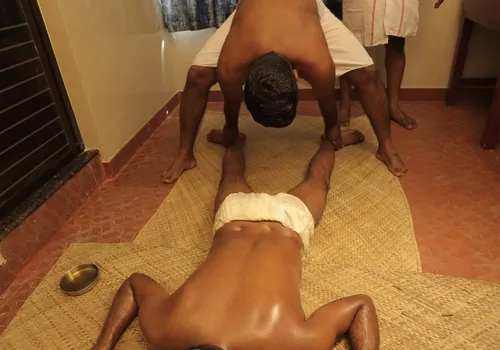
Our approach is led by Dr. T.D. Bose, who trained under Marmacharya Shri Sudheer Vaidhyar. Because Apabahuka is a Vata condition of the shoulder, treatment works on two fronts at once: loosening the stiff capsule locally, and pacifying the Vata that dried it out. Warm local therapies do the first — Naranga Kizhi and Ela Kizhi (medicated boluses) and Bashpa Swedam (herbal steam) soften and warm the shoulder, while Upanaham (a warm medicated poultice bandaged over the joint) sustains that effect between sessions.
For the second front we use classical Nasya — the nasal administration of medicated oil that Ayurvedic texts prescribe specifically for shoulder and neck disorders like Apabahuka, and the very therapy tested in the research above. Running through all of it, Marma Chikitsa works on the vital points around the shoulder to release spasm, improve circulation and restore movement. Most patients complete a 14–21 day in-patient course followed by take-home medicines and a guided movement plan.
Why patients choose us for frozen shoulder
Diet, Lifestyle & Movement for a Frozen Shoulder
Because Apabahuka is a Vata condition, warmth and gentle, steady movement are your allies, while cold and forced strain set it back. Our doctors tailor guidance to your stage; these are the principles we share most often.
Do
Keep the shoulder warm — warm clothing, a warm shower, or a warm compress before movement.
Eat warm, freshly cooked, mildly oily and nourishing food that pacifies Vata.
Do your prescribed gentle mobility exercises little and often, within a comfortable range.
Use warm sesame or medicated oil to gently massage the shoulder, as advised.
Sleep in a position that keeps the shoulder supported and unstrained.
Avoid
Cold exposure, cold water on the shoulder, and sitting under direct fans or AC on the joint.
Forcing or yanking the arm into painful ranges — especially during the painful freezing stage.
Carrying heavy bags or lifting overhead on the affected side while it is stiff.
Long spells of complete stillness — total rest lets the capsule tighten further.
Dry, cold and stale foods and irregular meals, which aggravate Vata.
A note on movement: gentle, regular movement is essential to thaw a frozen shoulder — but forcing it during the painful freezing stage inflames the capsule and sets you back. The skill is matching the movement to the stage, which is exactly what our doctors and therapists guide you through.
Recovery Stories from Our Patients
"I've been a patient here, and I've had great improvement because of the treatment. They provide a homely atmosphere here. The doctor and all the staffs are pleasant, cooperative and helpful. All the p..." Read more
"I am getting good treatment. 6 years ago, I did not get any relief from Ayurvedic English treatment for the same disease. So, I came here 6 years ago and got relief. Now, after 18 days of treatment, I..." Read more
Frozen Shoulder (Apabahuka) — Frequently Asked Questions
Can Ayurveda cure a frozen shoulder?
What is the best Ayurvedic treatment for frozen shoulder in Kerala?
How long does frozen shoulder treatment take?
What is Apabahuka in Ayurveda?
I have diabetes and a frozen shoulder — can you still help?
Should I exercise a frozen shoulder, or rest it?
Is a frozen shoulder the same as a rotator cuff tear?
Struggling to Lift Your Arm? Let's Look at Your Shoulder
Share your shoulder scan, reports, or just a description of what you can and can't do with our doctors for a free, no-obligation review. We'll tell you honestly how much movement our Apabahuka approach can help you recover — the same approach that has helped thousands of patients get their shoulders working again.