✦ NABH Certified Ayurvedic Hospital

Dhanyamla Dhara — Anti-inflammatory Decoction Therapy

Dhanyamla Dhara — A Warm Fermented-Decoction Stream for Inflamed Joints & Spine

The anti-inflammatory continuous-stream therapy for conditions where swelling, stiffness and inflammation dominate the pain.

At Agasthya, Dhanyamla Dhara is a cornerstone of our protocols for rheumatoid arthritis (Amavata), inflammatory back pain, sciatic flare-ups and swollen, stiff joints — including the morning stiffness of lumbar spondylosis. Unlike the oil-based streams, it pours a warm, mildly sour fermented grain decoction over the affected region — an acidic, penetrating liquid that breaks Kapha stagnation and reduces deep inflammation that oils alone struggle to reach. Prescribed for 7–14 day protocols by Dr. T.D. Bose, almost always alongside Marma Chikitsa and internal Ayurvedic medicines.

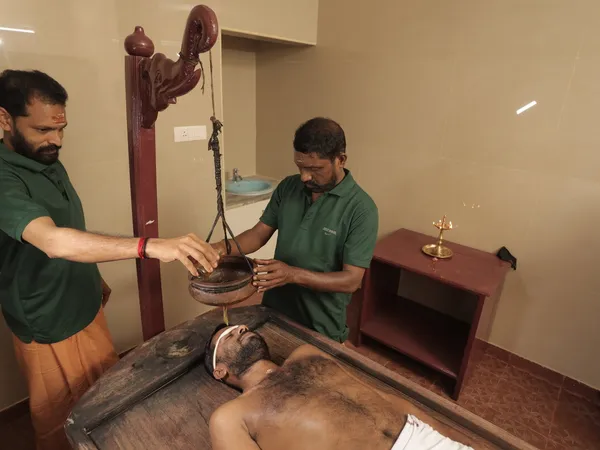
Dhanyamla Dhara warm fermented grain decoction stream therapy for rheumatoid arthritis and inflammatory back pain at Agasthya Kerala
7–14
Day Treatment Protocol
30+ Yrs
Of Authentic Ayurveda
NABH
Certified Ayurvedic Hospital
4.9/5
Rating from 200+ Reviews

What Is Dhanyamla Dhara?

Dhanyamla Dhara is a form of Sarvanga or Ekanga Dhara (whole-body or localised stream therapy) in which a warm, fermented grain decoction called dhanyamla is poured over the body in a continuous stream. The Sanskrit name says exactly what it is: Dhanya (grains / cereals), Amla (sour), Dhara (a continuous stream). Dhanyamla is prepared by fermenting grains, cereals and herbs over several days until it develops its characteristic mildly sour, acidic character.

The therapeutic logic is what sets it apart from oil-based streams like Pizhichil. In Ayurveda, most joint and spine pain that presents with swelling, stiffness, heaviness and inflammation is a Vata-Kapha problem complicated by Ama — undigested metabolic toxins that lodge in the joints. Rich, nourishing oils can make that heaviness worse. The warm, sour, penetrating nature of dhanyamla does the opposite: it is Ushna (heating) and Amla (sour), so it breaks up Kapha stagnation, mobilises Ama and reduces deep inflammation — reaching tissue that oil alone cannot. This is why Dhanyamla Dhara is one of the classical treatments of choice for rheumatoid arthritis (Amavata) and inflammatory joint disease.

The Dhanyamla Dhara Procedure — Step by Step

At Agasthya, Dhanyamla Dhara is performed by two trained therapists working in coordination, under the supervision of our doctors. Each session lasts 45–60 minutes. The skill is in keeping the stream continuous and the temperature uniform across the whole affected area for the full session.

1

Step 1 — Purva Karma (Preparation)

The session begins with a short warm oil application (Abhyangam) over the affected region — the back, the joints, or the whole body depending on the condition. This settles the surface tissue and prepares the channels (srotas) so the medicated decoction that follows can act more deeply. Meanwhile the dhanyamla is warmed to a precise, comfortable temperature.

2

Step 2 — Positioning on the Droni

The patient lies on the traditional wooden treatment table (droni) in the position that best exposes the affected area — prone for lumbar and spinal conditions, seated or supine for joints and limbs. The unaffected areas are kept covered and warm throughout.

3

Step 3 — Pradhana Karma (The Continuous Dhara)

Two therapists work in coordination to pour the warm fermented grain decoction (dhanyamla) in a steady, unbroken stream over the affected region from a fixed height. The stream is moved rhythmically to keep the whole area bathed in uniform warmth. The decoction is continuously re-collected, re-warmed and re-poured so the temperature never drops — this sustained warm, sour, acidic contact is what breaks Kapha stagnation and reduces deep inflammation.

4

Step 4 — Duration & Coverage

The continuous stream is maintained for 45–60 minutes so the anti-inflammatory decoction has time to penetrate the muscle, joint capsule and connective-tissue layers. Coverage is kept even across the whole affected region rather than concentrated on one spot — important for large areas such as the lumbar spine or a swollen knee.

5

Step 5 — Pashchat Karma (Post-procedure care)

The area is gently wiped and the patient rests in a warm, draught-free room. Light, warm, easily digestible food and warm water are advised for the rest of the day, along with the internal Ayurvedic medicines prescribed as part of the protocol. Avoiding cold exposure and over-exertion after the session helps the effect hold.

Key Benefits of Dhanyamla Dhara

Because Dhanyamla Dhara works through warm, sour, penetrating fermented decoction rather than oil, it produces benefits that are difficult to achieve where swelling and inflammation dominate the pain.

Deeply anti-inflammatory — especially effective where oils have plateaued
The sour, warming character of fermented decoction breaks Kapha stagnation in stiff, swollen joints
Reduces radiating, burning sciatic pain that has not responded to other approaches
Continuous-stream application delivers sustained warm contact across a large area
One of the primary therapies for rheumatoid arthritis (Amavata) in classical Ayurveda
Pairs naturally with Marma Chikitsa and internal medicines as part of an inflammatory-condition protocol

Dhanyamla Dhara vs Pizhichil — Which Stream, and When?

Both are continuous-stream (Dhara) therapies, but they do opposite jobs. Choosing the right one for your presentation is exactly the kind of decision Dr. Bose makes after examining your case.

Dhanyamla Dhara

  • • A warm, sour, fermented grain decoction
  • • Anti-inflammatory, anti-Kapha, penetrating
  • • For swelling, stiffness & inflammation (Vata-Kapha + Ama)
  • • First choice in rheumatoid arthritis, acute flare-ups, swollen joints

Pizhichil

  • • A warm, medicated oil stream
  • • Nourishing, lubricating, deeply anabolic
  • • For dryness, degeneration & weakness (aggravated Vata)
  • • First choice in chronic disc/nerve conditions once inflammation has settled

In many patients the two are used in sequence — Dhanyamla Dhara first to settle the inflammation, then oil-based therapies such as Pizhichil or Njavarakizhi to nourish and rebuild.

Conditions Dhanyamla Dhara Treats

Dhanyamla Dhara is prescribed wherever inflammation, swelling and stiffness lead the picture. At Agasthya, we use it most often for the following conditions, almost always alongside Marma Chikitsa and supporting internal medicines.

Rheumatoid Arthritis (Amavata)

One of the primary classical therapies for Amavata. Because RA is driven by Ama (metabolic toxins) settling in the joints, the sour, penetrating, non-oily character of dhanyamla helps clear that inflammation where nourishing oil therapies would be premature.

Learn more →

Sciatica with Radiating Pain

Used for sciatic (Gridhrasi) flare-ups where the leg pain is burning, radiating and Vata-aggravated — and has not settled with other approaches. It calms the acutely inflamed nerve root before deeper anabolic therapies are introduced.

Learn more →

Inflammatory & Acute Back Pain

For lumbar conditions in an inflammatory phase — acute disc flare-ups, hot and irritable low back pain — where the region is too inflamed for Njavarakizhi or Pizhichil to be the right starting point.

Learn more →

Knee Osteoarthritis & Inflammatory Knee

For swollen, warm, stiff knees where excess fluid and inflammation dominate. The warm decoction stream reduces the swelling and heaviness that make the joint painful to bend and bear weight.

Learn more →

Knee Ligament Injury — the Hot, Swollen Phase

A recently torn knee ligament is an inflammatory problem before it is a stiffness one, and warm oil applied to it in that phase sets it back. The cooling, astringent decoction stream is what that knee needs; the oil therapies belong later.

Learn more →

Varicose Veins — Swelling & Heaviness

Applied gently to bring down leg swelling and the heavy, fatigued feeling of varicose veins, as part of a combination protocol that keeps direct pressure off the affected veins.

Learn more →

Frozen Shoulder

For stubborn adhesive capsulitis where stiffness and inflammation limit range of motion. The sustained warmth loosens the tightened capsule and eases the pain that blocks movement.

Learn more →

Peripheral Neuritis & Diabetic Neuropathy

Used to reduce the inflammation and Vata aggravation behind burning, tingling nerve pain in the limbs, alongside internal medicines that address the underlying cause. In a diabetic foot it is often our choice precisely because it delivers warmth without the heat load of an oil dhara.

Learn more →

Hemiplegia & Post-stroke Rehabilitation

Part of the supportive rehabilitation protocol for post-stroke and hemiplegic patients, helping relieve stiffness and improve circulation in affected limbs.

What the Research Shows

Dhanyamla Dhara is not usually studied in isolation — it is one component of the broader Ayurvedic management of Amavata, the classical condition that closely mirrors rheumatoid arthritis (RA). That whole-system approach has been evaluated in clinical research. A single-centre randomised clinical study of Ayurvedic management of Amavata (Ayu, 2016) reported meaningful improvement in RA symptoms — pain, joint swelling, tenderness and morning stiffness — using classical Ayurvedic formulations and Panchakarma-based procedures.

This matters because it reflects how Dhanyamla Dhara is actually delivered here: as one part of an integrated protocol — external anti-inflammatory therapy, Marma Chikitsa, internal medicines that correct digestion and clear Ama, and a therapeutic diet — rather than a standalone procedure.

Reference: Vaghela DB, et al. “Clinical evaluation of efficacy of Alambushadi Ghana Vati and Vaitarana Basti in the management of Amavata with special reference to rheumatoid arthritis.” Ayu. 2016;37(2):105–112. PMID: 29200748.
Note: this evidence concerns the overall Ayurvedic management of Amavata (RA), not Dhanyamla Dhara in isolation. Individual results vary; treatment is always tailored after clinical assessment.

Treatment Duration & What to Expect

Dhanyamla Dhara is rarely prescribed on its own. At Agasthya it is part of a broader 7–14 day in-patient programme that combines the decoction stream with Marma Chikitsa, internal Ayurvedic medicines, and a Vata-Kapha-pacifying diet tailored to your condition.

7-Day Programme

Suitable for acute or recently aggravated conditions:

  • • Acute sciatic flare-ups with radiating pain
  • • Inflammatory low back pain
  • • A single swollen, stiff joint
  • • Recent-onset joint inflammation

14-Day Programme

Recommended for chronic and systemic conditions:

  • • Rheumatoid arthritis (Amavata)
  • • Long-standing inflammatory joint disease
  • • Chronic sciatica and disc flare-ups
  • • Peripheral neuritis and post-stroke stiffness

After Treatment — Continuing Care at Home

After the in-patient course, recovery continues with prescribed internal medicines, dietary discipline that keeps Ama from re-forming (warm, freshly cooked, easily digestible food), gentle movement, and avoidance of cold, damp exposure. Patients with rheumatoid arthritis are usually advised follow-up consultations at 3 and 6 months. Most patients report sustained relief when the post-treatment routine is followed for 8–12 weeks.

Patient Outcomes — Real Stories from Agasthya

Dhanyamla Dhara features in many of our inflammatory joint and spine protocols. These patients underwent treatment programmes that included decoction-stream and oil-stream (Dhara) therapies alongside Marma Chikitsa.

Disc Prolapse (L3) & Leg Pain — 18-Day Treatment

Raju P.K.

“I was admitted at Agasthya due to pain and stiffness in the left leg — as per the Ortho Surgeon I was having vertebral disc prolapse in L3, and I had suffered for two months. The treatment was very systematic: oil massage and steam bath, Oil Dhara, and finally Njavara kizhi, along with separate Ayurvedic medicines. Now my 18-day treatment is over and I am fully recovered from pain and stiffness — I am able to walk long distances again.”

18 days Recovered from pain & stiffness, walking again
Sciatica & Back Pain — 21-Day Treatment
"Had Sciatica problem and back pain. Thankful to God reached this centre after various treatments and admitted for 21 days with good hospitality and medical care from doctors and staffs, and continuing..."
Read more
Thiyagaraj Krishnan
Knee Pain — Surgery Avoided
"I had admitted my mother for knee pain — actually it was a surgical position; however they have given fantastic treatment for her and now she is able to walk. Also the receptionists are very responsib..."
Read more
Manickam P.

Why Receive Dhanyamla Dhara at Agasthya?

Dhanyamla Dhara is a clinical procedure, not a wellness add-on. The quality and freshness of the fermented decoction, its temperature, the continuity of the stream, the patient's positioning, and how it is sequenced with other therapies all materially affect the outcome. Done correctly, it can settle inflammation that other treatments cannot; done casually, it has limited effect.

At Agasthya, every Dhanyamla Dhara protocol is prescribed personally by Dr. T.D. Bose after evaluating your prakriti, MRI/X-ray reports, and current symptoms. The therapy team has been working with Dr. Bose since 1998, and our pharmacy prepares the dhanyamla and medicated preparations in-house. As an NABH-certified Ayurvedic hospital, we follow standardised protocols and maintain detailed clinical records for every patient.

For rheumatoid arthritis, inflammatory back pain, sciatica and swollen joints, Dhanyamla Dhara is most effective when integrated into a complete protocol with Marma Chikitsa, Marma Abhyangam, and internal Ayurvedic medicines — which is exactly how it is delivered here.

Dr. T.D. Bose — Chief Physician supervising treatment at Agasthya Ayurvedic Hospital Kerala

Dr. T.D. Bose — Chief Physician & Marma Chikitsa Specialist

Frequently Asked Questions about Dhanyamla Dhara

How is Dhanyamla Dhara different from Pizhichil?
Pizhichil pours warm medicated oil over the body — deeply nourishing, ideal for Vata-aggravated dryness and degeneration. Dhanyamla Dhara pours a warm fermented grain decoction — mildly sour, deeply anti-inflammatory, and far better suited to Vata-Kapha presentations where swelling, stiffness, and inflammation dominate. Both are continuous-stream therapies but the choice between them is condition-specific.
Which conditions is Dhanyamla Dhara most useful for?
It is one of the primary classical therapies for rheumatoid arthritis (Amavata), inflammatory joint disease, sciatic flare-ups with burning pain, peripheral neuritis, post-stroke rehabilitation, and stubborn frozen shoulder. We also rely on it for acute disc flare-ups where the patient is in too much inflammation for the deeper anabolic therapies (Njavarakizhi, Pizhichil) to be the right starting point.
What does the fermented decoction contain?
Dhanyamla is prepared by fermenting various grains, cereals, and herbs over several days to develop its characteristic sour, mildly acidic character. The exact composition is set by the treating physician based on your prakriti and condition. The fermentation gives dhanyamla its anti-Kapha, penetrating property — which is what distinguishes it from non-fermented therapies.
Is Dhanyamla Dhara safe? Are there any side effects or contraindications?
Dhanyamla Dhara is a gentle, well-tolerated external therapy with no systemic side effects when performed correctly. Because the decoction is warm and sour (Ushna and Amla), it is best suited to Vata-Kapha and inflammatory presentations and is generally avoided in acute Pitta-aggravated states with burning, redness and severe heat, over broken or infected skin, and in high fever. It is always prescribed after Dr. T.D. Bose reviews your prakriti, reports and current symptoms, and the temperature and duration are adjusted to you.
How many days of Dhanyamla Dhara will I need?
Each session lasts about 45–60 minutes and is typically given over 7–14 days as part of a broader in-patient protocol. It is rarely done in isolation — it is combined with Marma Chikitsa, internal Ayurvedic medicines and a therapeutic diet. The exact number of days depends on the condition and its severity, and is decided by the consulting physician after examining your case.
What does the treatment feel like — and does the decoction have a smell?
Most patients find the continuous warm stream deeply soothing and often relaxing enough to fall asleep during the session. Dhanyamla is a fermented preparation, so it has a characteristic mild sour, slightly acidic smell — this is normal and is exactly the property that gives the therapy its anti-inflammatory, anti-Kapha action. The smell washes off easily and does not linger.
Can Dhanyamla Dhara be combined with Marma Chikitsa and internal medicines?
Yes — that is how it is almost always delivered at Agasthya. Dhanyamla Dhara settles the inflammation externally while Marma Chikitsa works on the vital points and internal medicines correct digestion and clear Ama from within. Combining the external, point-based and internal approaches is what makes the results hold rather than fade after the course ends.
How soon will I feel relief from Dhanyamla Dhara?
Many patients with inflammatory joint pain, swelling and stiffness notice reduced heaviness and easier movement within the first few sessions. Deeper, lasting change in chronic conditions such as rheumatoid arthritis usually builds over the full 7–14 day protocol and continues with the prescribed home medicines. Recovery in Ayurveda is steady rather than instant — but it addresses the root inflammation, not just the symptom.

Considering Dhanyamla Dhara? Speak to our Doctors First.

Whether you're dealing with rheumatoid arthritis, inflammatory back pain, a sciatic flare-up, or a swollen, stiff joint — the right therapy depends on your prakriti, your reports, and the underlying condition. A short consultation with Dr. Bose will tell you exactly what's needed, in person or online.

Call us: +91 93884 77762

Online consultations available — we treat patients from UAE, Canada, Belgium and across India

Medically reviewed by Dr. T.D. Bose, Chief Physician, Agasthya Ayurvedic Hospital. Last updated: July 29, 2026.

Chat with us